Saturday, March 14, 2015

Moving Day

     I only went to the museum for one day this week for 2 hours and 45 minutes, but it was a very productive day. I started out by carrying out the same cleaning routine as last week, but it quickly became a moving day. First of all I found out that the 4th floor of the museum is being cleaned out. Up until this point we had a few larger jackets and quite a few buckets of matrix and plaster stored up there. For roughly the first half of my time at the museum I helped David load up the cart a couple times and move the majority of the items down to the lab. The second part of this was to clean off some shelves and more thoroughly pack others so we could fit everything. It's amazing how much stuff is in the lab. It's funny because when I used to think of a lab I would think of a clean, sterile environment, but not anymore. There are definitely some labs that are like this, and have to be, but in a paleo lab there's just so much dirt. This is because when we clean bones we're cleaning dirt off of them. And when we were moving things in we moved in quite a few buckets of dirt, matrix. 
     After everything was moved in I got to help de-install two fossil mounts. The reason that they were being removed and put into storage is so that the wall they were sitting on can be knocked down and cases that are lower down can be made for them. This will make it easier for people to view them, being that they are pretty cool specimens. You can see pictures of them on the carts below. 


Tuesday, March 10, 2015

The Cleaning Process

     On Day 1 I was in the lab for 2 hours. All my time was spent using the air scribe to remove small amounts of caliche covering part of a limb bone. I think so far the air scribe has to be my favorite lab or field tool that I've used. Even though I have to be super careful and use magnification so that I don't touch the bone there's something satisfying about seeing small bits of caliche chip away to reveal clean, smooth, beautiful bone. You can see the process on a small part of the bone by looking at pictures 1-3. Picture 1 has a small bit of cleaning done in the top left corner, picture 2 shows this closer up, and picture 3 has all the cleaning completed. I followed this up by working on some more of the little bits of bone that were almost exposed. You can see the line between brown and white on the pictures that shows this. I really want to try the air abrasion unit, which is like the air scribe but not as strong, because I think that would make cleaning off this really thin layer much easier.
     On Day 2 I was in the lab for 2.5 hours. This day I went through the cleaning process with almost all the stray Jane bones that were left. First I removed the big clumps on dirt with a dental pick. Then I bathed them in vinegar and scrubed them with a toothbrush. Next I did the same thing but with water. After that I removed much of the remaining dirt with a dental pick. As you can see in the pictures the caliche on the bones actually goes from being stained red to a grayish color. This is another satisfying sight to me after I've cleaned a bone, because it feels like I've really made progress, and progress isn't usually something that comes quickly in Paleontology.


Tuesday, March 3, 2015

Vinegar & Water

     On day 1 I went to the museum for 1 1/2 hours. On this day I worked with water and the dental pick to continue cleaning the bone I was working on last time. There's so much dirt on these bones, so they take quite a bit of cleaning. The other difficulty with these bones is that they've been sitting for a year with the dirt drying out on them. This means that I have to use a lot of water to loosen the dirt up so I can get it off. I think I need to scrub these bones down with water and a toothbrush to loosen up the dirt enough to really remove it all. I'm excited to get them cleaned so I can play around with them to see how they fit together.

     On day 2 I went the lab for 2 1/4 hours. This time I decided to work with another one of the bones I've been working on to practice cleaning with vinegar. I started out with cotton swabs and vinegar, which worked well but was using a lot of cotton swabs for not a lot of progress so I changed my tactic. I decided instead to scrub the bone down with vinegar and a toothbrush to loosen up more of the dirt. This plan worked really well and I was able to get the majority of the dirt loosened up. I followed this up with water and a toothbrush so that the vinegar wouldn't be left of the bone to eat away at it, this is a very important step. After this process I was able to get the majority of the dirt off. So I followed this up with the small air scribe to take off small amounts of caliche at a time. You can see the progress below. 


Tuesday, February 24, 2015

Losing the Red

     Last week I had a meeting about the Paleontology A-Term for 1 1/4 hours and did prep-work for an hour.
     During the meeting Dr. Ott and I finalized the budget and chaperones for the trip, got the readings together, and wrote up a syllabus and description.
     In the lab I worked more on removing the very red dirt from the Jane bone I've been working on for a couple weeks now. I'm finding that the vinegar does a much better job of loosening the dirt from the bone than the water does. The one thing I have to be careful with when using vinegar is that I remove it in a timely fashion, because if it sits on the bones for too long it can start to erode them. You can see how much red dirt I've been able to remove from the bones using the vinegar and a dental pick.


Sunday, February 15, 2015

The Petrified Wood Vault

     Last week I go to go to the museum for an hour because we had a shortened week of school. While there I got to go with David to pick out a slab of petrified wood for a display and learned where all the petrified wood is kept. As you can see below that there's a lot of it, and some of it is very heavy! I wonder how much prep work has to be done on petrified wood when it's found? I don't know if it gets some sort of caliche on it or if it's typically cleaner than fossils are. I will ask David about this next time I seem him and let you all know. After looking at the petrified wood I was able to do a little bit more cleaning on the Jane bone from last week for about fifteen minutes before I left.


Sunday, February 8, 2015

Vinegar, Some Big Bones, and a Database

     This week I went to the museum once for 2 1/4 hours. David was out of town,  and I needed to talk to him about trimming the plaster of my large jacket, so I decided I would work on my small jacket instead. I had forgotten that the small jacket was completely done except for one small part because of how many bones were on top of the dirt there. Originally I thought there were only a couple bones so I could just label and remove them, but when I saw how many small pieces of bone there were I decided against that. So when David gets back I'll need his help cutting plaster and photographing the small jacket so I can remove those bones and then finish removing dirt.
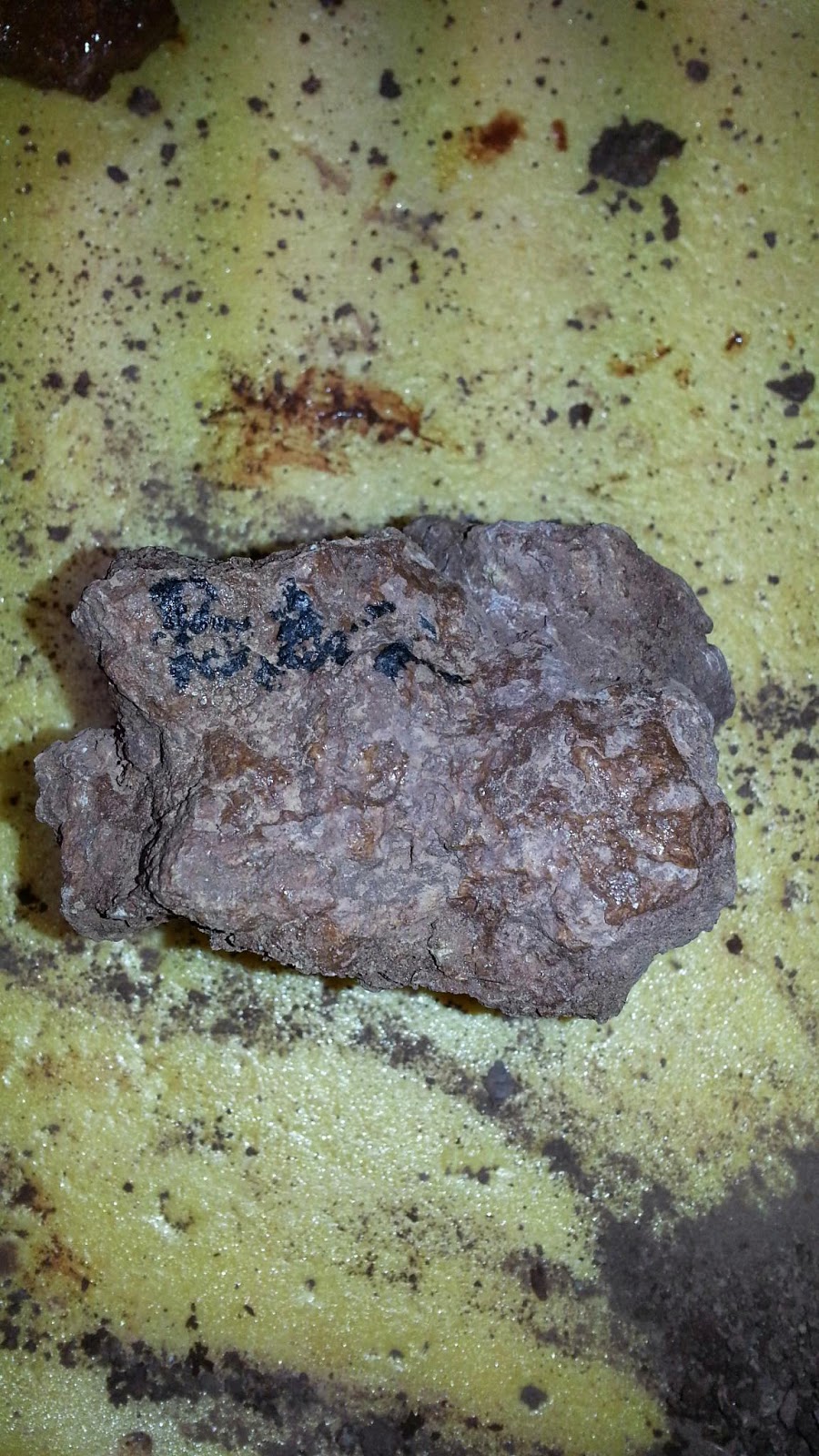
     We brought back a couple sets of bones wrapped in aluminum foil when we came back from Seymour last year, and I realized last week that they never got cleaned. So I decided to work on those after the jackets were a bust. The reason we didn't make a jacket around these bones was because they'd already moved around so much in the field that we didn't really need to preserve their location. Instead we drew and photographed them, labeled them with Sharpie because the caliche will be removed later, and collected them. I got to work on two of the bones while I was in the lab this last week, and neither are done being cleaned. I started by spraying the first bone down with water and using a dentil pick to remove large amount of dirt. I followed that by scrubbing down the bone with vinegar and a toothbrush. While I let that sit for 10-15 minutes I started doing the same thing on a second bone. After 10-15 minutes I picked more dirt off of the first bone with a dental pick and then scrubbed it down with water and a toothbrush to get the vinegar off. I ended up having to dry the bone by hand because that's when I had to leave, but I'll work more on this set of bones next week.
     Check out pictures of the cleaning process below!
     I also got to talk to one of the other volunteers about the database he's spearheading to enter all of our fossils into; that's a picture of it at the very bottom.